 |
FOSSology
4.7.1
Open Source License Compliance by Open Source Software
|
|
FOSSology
4.7.1
Open Source License Compliance by Open Source Software
|
Scheduler operations. More...
#include <libfossrepo.h>#include <agent.h>#include <database.h>#include <event.h>#include <host.h>#include <interface.h>#include <scheduler.h>#include <fossconfig.h>#include <stdio.h>#include <stdlib.h>#include <string.h>#include <dirent.h>#include <fcntl.h>#include <signal.h>#include <sys/mman.h>#include <sys/types.h>#include <sys/wait.h>#include <unistd.h>#include <pwd.h>#include <grp.h>#include <glib.h>#include <gio/gio.h>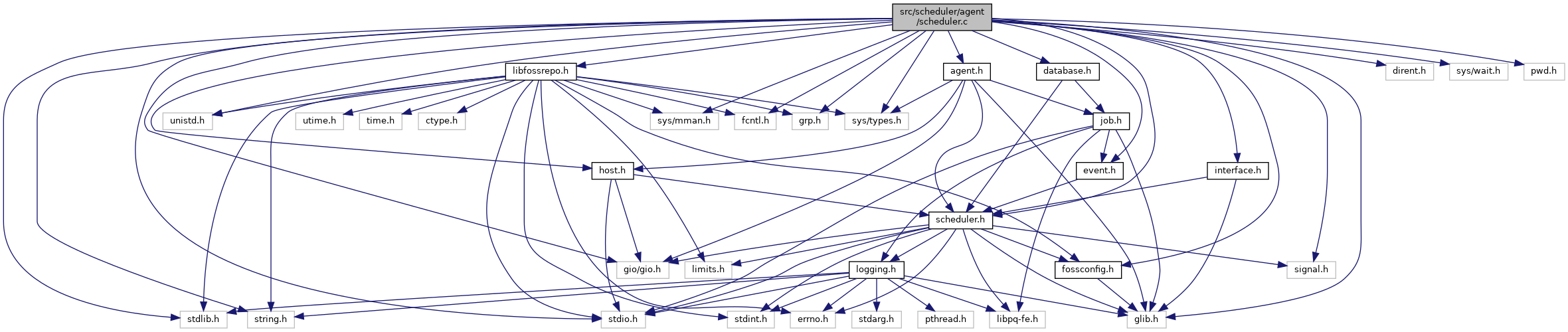
Go to the source code of this file.
Classes | |
| struct | stale_ctx |
| Context for collect_stale_jobs traversal: carries current time so each node can apply a per-job grace period without an extra pass. More... | |
| struct | version_refresh_ctx |
| Context structure for the version-refresh tree traversal. More... | |
Macros | |
| #define | TEST_ERROR(error, ...) |
| #define | SELECT_DECLS(type, name, l_op, w_op, val) type CONF_##name = val; |
| #define | MASK_SIGCHLD (1 << 0) |
| #define | MASK_SIGALRM (1 << 1) |
| #define | MASK_SIGTERM (1 << 2) |
| #define | MASK_SIGQUIT (1 << 3) |
| #define | MASK_SIGHUP (1 << 4) |
| #define | GU_HEADER "DIRECTORIES" |
| #define | GU_GROUP "PROJECTGROUP" |
| #define | GU_USER "PROJECTUSER" |
| #define | SELECT_CONF_INIT(type, name, l_op, w_op, val) |
Functions | |
| void | scheduler_sig_handle (int signo) |
| Handles any signals sent to the scheduler that are not SIGCHLD. More... | |
| void | scheduler_signal (scheduler_t *scheduler) |
| Function that handles certain signals being delivered to the scheduler. More... | |
| scheduler_t * | scheduler_init (gchar *sysconfigdir, log_t *log) |
| Create a new scheduler object. More... | |
| void | scheduler_destroy (scheduler_t *scheduler) |
| Free any memory associated with a scheduler_t. More... | |
| static gboolean | isMaxLimitReached (meta_agent_t *agent) |
| Check if the current agent's max limit is respected. More... | |
| static gboolean | collect_stale_jobs (gpointer key, gpointer val, gpointer data) |
| GTraverseFunc: collect CHECKEDOUT jobs with no agents that have been waiting longer than CONF_agent_update_interval seconds. More... | |
| static void | reap_stale_jobs (scheduler_t *scheduler) |
| Reap CHECKEDOUT jobs that never had an agent spawned. More... | |
| void | scheduler_update (scheduler_t *scheduler) |
| Update function called after every event. More... | |
| void | set_usr_grp (gchar *process_name, fo_conf *config) |
| int | kill_scheduler (int force) |
| Kills all other running scheduler. More... | |
| void | scheduler_clear_config (scheduler_t *scheduler) |
| Clears any information that is loaded when loading the configuration. More... | |
| static gboolean | g_tree_collect (gpointer key, gpointer value, gpointer data) |
| GTraverseFunc used by g_tree_clear to collect all the keys in a tree. More... | |
| void | g_tree_clear (GTree *tree) |
| Clears the contents of a GTree. More... | |
| void | scheduler_agent_config (scheduler_t *scheduler) |
| Loads a particular agents configuration file. More... | |
| void | scheduler_foss_config (scheduler_t *scheduler) |
| Loads the configuration data from fossology.conf. More... | |
| int | scheduler_daemonize (scheduler_t *scheduler) |
| Daemonizes the scheduler. More... | |
| void | scheduler_config_event (scheduler_t *scheduler, void *unused) |
| Load both the fossology configuration and all the agent configurations. More... | |
| void | scheduler_close_event (scheduler_t *scheduler, void *killed) |
| Sets the closing flag and possibly kills all currently running agents. More... | |
| void | scheduler_test_agents (scheduler_t *scheduler, void *unused) |
| Event used when the scheduler tests the agents. More... | |
| static gboolean | version_refresh_kill_agent (int *pid_ptr, agent_t *agent, version_refresh_ctx *ctx) |
| GTraverseFunc: respawn a not-yet-working agent on the new binary. More... | |
| void | scheduler_version_refresh (scheduler_t *scheduler, void *unused) |
| Event run when the scheduler's own version changed. More... | |
| gint | string_is_num (gchar *str) |
| Checks if a string is entirely composed of numeric characters. More... | |
| gint | string_compare (gconstpointer a, gconstpointer b, gpointer user_data) |
| gint | int_compare (gconstpointer a, gconstpointer b, gpointer user_data) |
Variables | |
| int | verbose = 0 |
| The verbose level. More... | |
| int | closing = 0 |
| Set if scheduler is shutting down. | |
| GThread * | main_thread |
| Pointer to the main thread. | |
| int | sigmask = 0 |
Scheduler operations.
Definition in file scheduler.c.
| #define SELECT_CONF_INIT | ( | type, | |
| name, | |||
| l_op, | |||
| w_op, | |||
| val | |||
| ) |
| #define TEST_ERROR | ( | error, | |
| ... | |||
| ) |
Test if error is not NULL then print it to the log.
Definition at line 44 of file scheduler.c.
|
static |
GTraverseFunc: collect CHECKEDOUT jobs with no agents that have been waiting longer than CONF_agent_update_interval seconds.
The grace period avoids flagging a job that was just loaded from the DB and is still waiting for the scheduling loop to start its agent.
| key | unused |
| val | job_t* |
| data | stale_ctx* |
Definition at line 444 of file scheduler.c.
| void g_tree_clear | ( | GTree * | tree | ) |
Clears the contents of a GTree.
| tree | the tree to remove all elements from |
Definition at line 899 of file scheduler.c.
|
static |
GTraverseFunc used by g_tree_clear to collect all the keys in a tree.
| key | The current key |
| value | The value mapped to the current key |
| data | A GList** that the key will be appended to |
Definition at line 885 of file scheduler.c.
| gint int_compare | ( | gconstpointer | a, |
| gconstpointer | b, | ||
| gpointer | user_data | ||
| ) |
Utility function that enable the agents to be stored in a GTree using the PID of the associated process.
| a | The pid of the first process |
| b | The pid of the second process |
| user_data | unused in this function |
Definition at line 1361 of file scheduler.c.
|
static |
Check if the current agent's max limit is respected.
Compare the number of running agents and run limit of the agent.
| agent | Agent which has to be scheduled. |
Definition at line 409 of file scheduler.c.
| int kill_scheduler | ( | int | force | ) |
Kills all other running scheduler.
| force | if the scheduler should shutdown gracefully |
This uses the /proc file system to find all processes that have fo_scheduler in the name and sends a kill signal to them.
Definition at line 795 of file scheduler.c.
|
static |
Reap CHECKEDOUT jobs that never had an agent spawned.
Skipped while shutting down: at close, CHECKEDOUT jobs with no agents are still valid in-flight work and should be left in the DB for the next start, not failed here.
| scheduler | the scheduler |
Definition at line 482 of file scheduler.c.
| void scheduler_agent_config | ( | scheduler_t * | scheduler | ) |
Loads a particular agents configuration file.
This loads and saves the results as a new meta_agent. This assumes that the configuration file for the agent includes the following key/value pairs:
Definition at line 921 of file scheduler.c.
| void scheduler_clear_config | ( | scheduler_t * | scheduler | ) |
Clears any information that is loaded when loading the configuration.
| scheduler | the scheduler to reset the information on |
Definition at line 846 of file scheduler.c.
| void scheduler_close_event | ( | scheduler_t * | scheduler, |
| void * | killed | ||
| ) |
Sets the closing flag and possibly kills all currently running agents.
This function will cause the scheduler to slowly shutdown. If killed is true this is a quick, ungraceful shutdown.
| scheduler | the scheduler |
| killed | should the scheduler kill all currently executing agents before exiting the event loop, or should it wait for them to finished first. |
Definition at line 1220 of file scheduler.c.
| void scheduler_config_event | ( | scheduler_t * | scheduler, |
| void * | unused | ||
| ) |
Load both the fossology configuration and all the agent configurations.
| scheduler | the scheduler to load the configuration for |
| unused | this can be called as an event |
Definition at line 1197 of file scheduler.c.
| int scheduler_daemonize | ( | scheduler_t * | scheduler | ) |
Daemonizes the scheduler.
This will make sure that the pid that is maintained in the scheduler struct is correct during the daemonizing process.
| scheduler | the scheduler_t struct |
Definition at line 1179 of file scheduler.c.
| void scheduler_destroy | ( | scheduler_t * | scheduler | ) |
Free any memory associated with a scheduler_t.
This will stop the interface if it is currently running, and free all the memory associated with the different regular expression and similar structures.
| scheduler |
Interface close
Repo close
Definition at line 364 of file scheduler.c.
| void scheduler_foss_config | ( | scheduler_t * | scheduler | ) |
Loads the configuration data from fossology.conf.
This assumes that fossology.conf contains the following key/value pairs:
There should be a group named HOSTS with all of the hosts listed as key/value pairs under this category. For each of these hosts, the scheduler will create a new host as an internal representation.
Definition at line 1031 of file scheduler.c.
| scheduler_t* scheduler_init | ( | gchar * | sysconfigdir, |
| log_t * | log | ||
| ) |
Create a new scheduler object.
This will initialize everything to a point where it can be used. All regular expressions, GTree's and the job_queue will be correctly created.
| sysconfigdir | Directory containing the fossology.conf |
| log | Log file to log messages to |
Definition at line 249 of file scheduler.c.
| void scheduler_sig_handle | ( | int | signo | ) |
Handles any signals sent to the scheduler that are not SIGCHLD.
Currently Handles:
| Signal | Effect |
|---|---|
| SIGCHLD | Scheduler will handle to death of the child process or agent |
| SIGALRM | Scheduler will run agent updates and database updates |
| SIGTERM | Scheduler will gracefully shut down |
| SIGQUIT | Scheduler will forcefully shut down |
| SIGHIP | Scheduler will reload configuration data |
| signo | the number of the signal that was sent |
Definition at line 93 of file scheduler.c.
| void scheduler_signal | ( | scheduler_t * | scheduler | ) |
Function that handles certain signals being delivered to the scheduler.
This function is called every time the event loop attempts to take something from the event queue. It will also get called once a second regardless of if a new event has been queued.
This function checks the sigmask variable to check what signals have been received since the last time it was called. The sigmask variable should always be accessed atomically since it is accessed by the event loop thread as well as the signal handlers.
| scheduler | Scheduler to sent signal to |
Definition at line 142 of file scheduler.c.
| void scheduler_test_agents | ( | scheduler_t * | scheduler, |
| void * | unused | ||
| ) |
Event used when the scheduler tests the agents.
| scheduler | the scheduler struct |
| unused |
Definition at line 1235 of file scheduler.c.
| void scheduler_update | ( | scheduler_t * | scheduler | ) |
Update function called after every event.
The heart of the scheduler, the actual scheduling algorithm. This will be passed to the event loop as a call back and will be called every time an event is executed. Therefore the code should be light weight since it will be run very frequently.
Allow for runonpfile jobs to have multiple agents based on size
Allow for job preemption. The scheduler can pause jobs, allow it
Allow for specific hosts to be chosen.
Definition at line 564 of file scheduler.c.
| void scheduler_version_refresh | ( | scheduler_t * | scheduler, |
| void * | unused | ||
| ) |
Event run when the scheduler's own version changed.
Kills the agents that can be respawned so they pick up the new binary on the next scheduler_update(). Triggered by scheduler_foss_config() when COMMIT_HASH changes between two config loads (e.g. SIGHUP after a rebuild).
| scheduler | the scheduler |
| unused | ignored (required by event signature) |
Definition at line 1306 of file scheduler.c.
| void set_usr_grp | ( | gchar * | process_name, |
| fo_conf * | config | ||
| ) |
Correctly set the project user and group. The fossology scheduler must run as the user specified by PROJECT_USER and PROJECT_GROUP since the agents must be able to connect to the database. This ensures that that happens correctly.
| process_name | |
| config |
Definition at line 732 of file scheduler.c.
| gint string_compare | ( | gconstpointer | a, |
| gconstpointer | b, | ||
| gpointer | user_data | ||
| ) |
Utility function that enables the use of the strcmp function with a GTree.
| a | The first string |
| b | The second string |
| user_data | unused in this function |
Definition at line 1347 of file scheduler.c.
| gint string_is_num | ( | gchar * | str | ) |
Checks if a string is entirely composed of numeric characters.
| str | the string to test |
Definition at line 1328 of file scheduler.c.
|
static |
GTraverseFunc: respawn a not-yet-working agent on the new binary.
Resets every meta agent's cached version so the first respawned agent of each type sets the new one.
Only AG_SPAWNED agents are killed (job still JB_CHECKEDOUT, no data sent): the death event re-queues those for a fresh dispatch. AG_RUNNING agents are left to finish on the binary they started with, otherwise their half-done job would be marked complete.
| pid_ptr | Key in the agents GTree (pid) |
| agent | The running agent |
| ctx | version_refresh_ctx* |
Definition at line 1270 of file scheduler.c.
| int verbose = 0 |
 1.9.1
1.9.1